PISA 2025
Information about the 2025 cycle of the study: sample, stages, methodology and assessment instruments.
About the 2025 cycle
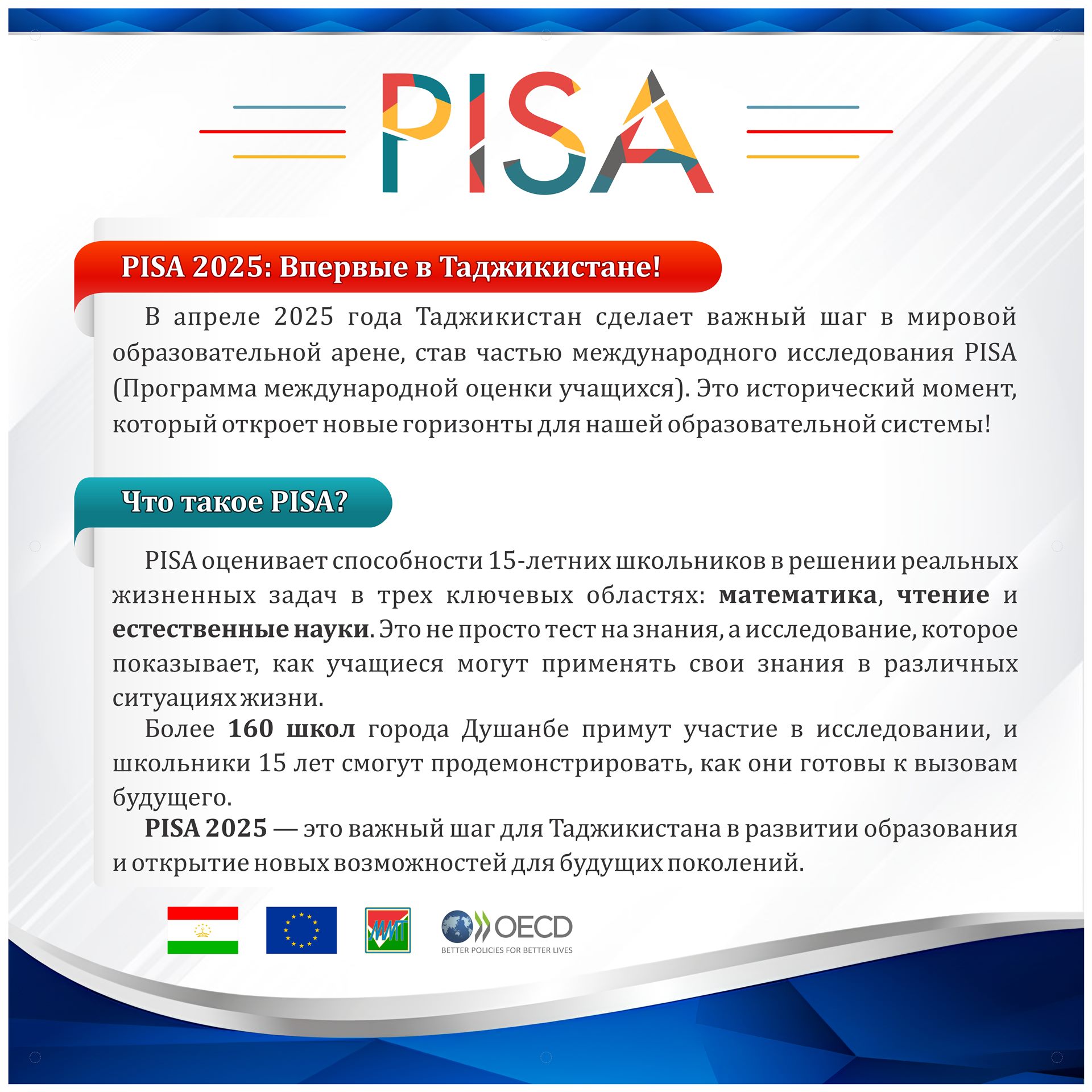
The PISA 2025 cycle continues the international assessment with science as the major domain, alongside reading and mathematics. For Tajikistan, PISA 2025 is the country's first-ever participation in the study.
Sample and participants
Target population
Sampling design
Instruments
Figures refer to Dushanbe, where the PISA 2025 sample for Tajikistan was drawn, and are preliminary operational data pending the National PISA 2025 Report.
Stages of the study
Preparation (2023-2024)
Adapting and translating instruments, training the national team and school coordinators.
Field Trial (May 2024)
Piloting test items and questionnaires in 71 schools in Dushanbe; 93.7% of sampled students took part.
Main Survey (April 2025)
Administering the assessment in 160 schools in Dushanbe; 5,778 students took part (preliminary figures).
Coding, analysis & reporting (2025-2026)
Coding responses, processing data and preparing the National PISA 2025 Report.
Methodology
PISA uses standardised international procedures for sampling, test administration and scoring to ensure that results are valid, reliable and comparable across countries.
In Tajikistan, the assessment is administered in Tajik and Russian, the languages of instruction of the participating schools. Each session lasts around two hours, covering reading, mathematics and science, followed by a background questionnaire. Ahead of the Main Survey, schools received a booklet of sample questions (printed in Tajik and Russian) so that students, teachers and parents could see the format of the assessment in advance.